Outlook stuck offline?

I’ve had this problem intermittently for a while now and it’s driving me crazy.  Of course it only happens when I’m out of the office on VPN.  Here are the steps to reproduce it:

  1. Initiate VPN
  2. Launch Outlook

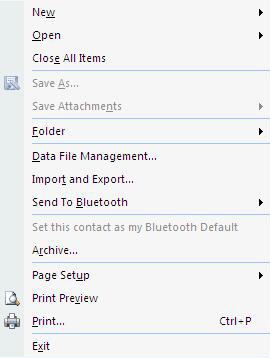
Standard procedure right?  Sure except my Outlook seems to enjoy getting stuck in Offline mode with absolutely no way to get it back.  Before you suggest selecting Go Online from the file menu, have a looksee …

outlook offline no workie

Notice anything missing?  Exactly.

Maybe T-Mobile wasn’t sleeping this whole time

Walking to the train tonight it suddenly hit me how awesome T-Mobile’s network announcement (Full HSPA+) was today.  It’s unclear how long they knew the Nexus One was coming, but clearly they knew enough and had enough lead time to pump out the upgrades for launch day.  Doing so takes the network issue  largely off the table.  By partnering with Google, they were able to ride the wave into what will hopefully be the start to how consumers consider their mobile purchase.  AT&T … not quite so fast.

Google has confirmed that Nexus One, and all subsequent Google phones sold via the company’s online store, will be available unlocked for use on every participating carrier. If a particular Google-branded phone is not on a particular carrier, then that’s only because that phone doesn’t have the proper radio to support its network. In addition to being unlocked, the phones will also have bundled plan options where the pricing and details are up to the carrier.

By offering a lineup of phones that is essentially carrier-independent (with the radio compatibility caveat), Google has separated the two previously interlocked parts of the phone/plan-buying experience—phone selection and carrier selection—and has done so in a way that threatens one of the most important enablers of carrier lock-in.

In short, what Google announced today wasn’t just the Nexus One, but the world’s first carrier-independent smartphone store; the Google store is now the only smartphone store in the world where, for every phone on offer, you first pick which phone you want, and then you pick a network and a plan on that network. So you can comparison shop among networks based purely on plan price and network quality, because you already have your phone picked out. via Ars Technica

I’m intrigued by the Nexus One, but not buying anytime soon. I definitely like where Android is going and have a good deal of respect for what Google is trying to do. I’m just not compelled enough to pick up a second mobile bill (@ $80/mo+tax) especially since while the G phones run on GSM, it’s another network band meaning sadly I still do need to consider where I want my 3G.

Google’s Favorite Places not quite that helpful

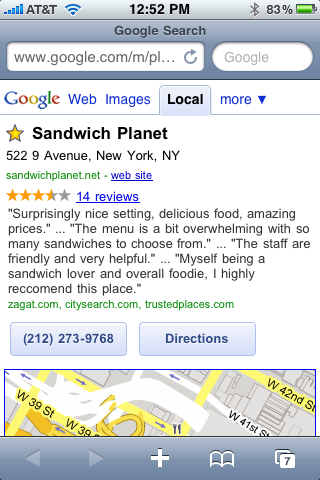
Today I caught a sticker in the sandwich shop by the office for Favorite Places on Google and decided to give the QR code a shot. Here’s what I got in return:

Sandwich Planet via Google Favorite Places

Reviews are helpful if I’ve never been t here before but needing to call or get directions (standing at the door) seems like a total waste.  Where are the daily specials, or perhaps a default to let me add my own review right away …   I was at least able to add it as a favorite, but I’ll need to open Maps on my desktop or Google Earth to get the benefit of saving it.  These types of services needs to be much more contextually relevant to matter.

Nokia suggests waiting just one more year

I missed this piece while writing my last post. It doesn’t say anything too specific about the higher end market (like nothing) but does indicate we’ll keep on waiting to see what Nokia has in store … I’m looking forward to seeing how the service integration evolves is revealed.

(Nokia’s executive vice-president and head of the mobile phones, Rick Simonson) I can even make a prediction for 2010: In Latin America, we will grow faster than them. By 2011, our efforts will start producing results, as we will be at par with Apple and RIM in smartphones. Not only we draw level with them, we will also win the war because, in addition to email, we will be adding content, chat, music, entertainment and several other features, which will soon become very critical for success of any company in this space.

Another crucial factor that will play a large role in our success is that we have the power of open operating system coupled with the open distribution model that is not restricted by geographical or technology boundaries. Look at our targets for any segment of our devices for 2010 — they are all 2-10 times that of any of our competitors. via The Economic Times.

Symbian Foundation confirms Nokia’s focus

I just caught a very interesting and revealing post over on the Symbian Foundation’s Blog … The key quote for me was the following:

Nokia’s endorsement of Symbian specifically marks out our future as a mobile computing and communications platform for the masses, globally marketed in smartphones costing $150 and under, and being an essential ingredient for helping others embrace the power of new types of communication.

Symbian will maintain it’s role as the smartphone for the masses which is where such a powerful, flexible platform belongs. An exciting aspect of this is that it also means that the offering will continue to have a huge impact on the lifestyles of people around the world.

This essentially confirms Nokia is done with the high end market for Symbian and I don’t care what the public talking heads keep saying about Symbian being their core smartphone OS.  The cues have all been there, but now stated publicaly, we see that Nokia’s smartphone for the masses truly does indicate a focus on mid-tier products given the price points and certainly retains Nokia’s focus on emerging markets as well.

It’s great to see that what we currently define as smartphones will be moving downstream to offer more capabilities to more people.  It’s also quite sad though that Nokia has yet to make a real move on the upper end to attract and retain interest in both developer and prosumer markets.

Before anyone jumps all over me for not bringing up Maemo

The N900 is a nice device, but it’s still way to hyper focused on the geek, and not ready for a mass market audience.  I’m sure there are more steps in the master plan for how Maemo will evolve, but they have yet to be revealed on any level  and whatever rumors have trickled out have yet to be stated boldly enough to instill confidence.  Nokia did not even have the courage to market it against the N97 (a vastly inferior S60 product) last year.  All the current efforts for Maemo are still largely based in WOM … no real push upstream to a broader market.

What a difference a year makes!  Last year, I carried two Symbian devices, had my N810 in my travel bag and regularly rotated through devices as the situation warranted.  I probably had between 3-5 additional Nokia devices within an arm’s reach.  Today, I am not carrying any Symbian devices and there is no Nokia gear in my bag either.  I’ve got an iPhone 3GS and a Blackberry Bold 9700.  I don’t feel like I’m missing anything … in fact just the opposite.  While I was so hyper focused on supporting Nokia, I failed to notice how quickly the Blackberry platform had evolved and though I tried to ignore it, was all to aware of what was happening with the iPhone.

Nokia has yet to actually change their game though we all know the rules changed a few years ago.  Perhaps there’s still a surprise waiting, though it looks like the same show has simply traveled to a new town.

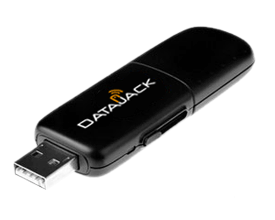
DataJack – Unlimited 3G Mobile Broadband

datajack

$99 for the modem and then only $39.99 per month for unlimited 3G Access … sounds like a great deal!  This is at leas $20 less a month than anything else on the market.

The DataJack USB modem costs $99.99 and unlimited, high speed, nationwide internet access costs only $39.99 per month. Because there are no activation or termination fees and no contract, you can turn the service on and off as you wish.

DataJack Bonus:

If you stay connected for 12 consecutive months, you will earn one FREE month of unlimited 3G Internet access!

Yes, DataJack Service is truly unlimited. You can leave it connected to the Internet 24 hours a day and not worry about any overage charges.

via Andy Abramson who also noticed this seems to be running on top of T-Mobile … so be sure to check you’ve got coverage if you want to go for it.

Cablevision drops Scripps Networks

We just noticed that both Food Network and HGTV were showing blanks on the cable guide and it seems just like TWC and Fox, that Cablevision and Scripps are not able to reach an agreement on the value of the station. My wife loves HGTV and we do also watch a bit of Food Network (Diners, Drive throughs and Dives anyone?). Even though we don’t spend hours a day watching TV, it’s really annoying to see channels just vaporize. Scripps has set up pages for both Food and HGTV to provide info and make sure you can take the appropriate action to try and get the stations back.

Cablevision usually does the right thing and provides excellent service (in general). It would be good to see things sorted out …

UPDATE This is now resolved and the channels are back!

Jolicloud Pre-Release

I’m writing this in the browser as I tend to do, though instead of running Windows or OSX, I’m using Jolicloud on my netbook.  I’ve had it loaded previously, but since I hacked the system with a new wireless card (to hackintosh) it failed to work without a wired connected, severely limiting my desire to use it.  Recently though Jolicloud released a more public beta and I loaded it up yesterday from Windows 7 and Jolicloud took care of everything …

A few system updates later (seems every OS has that post load) I’m really pleased with how Jolicloud runs.  The metaphor is a bit different than most operating systems – for starters, you need to have a live connection to do most everything.  This is great for most things, but something to really consider if you travel around as you won’t be able to do much without finding your way online.

Jolicloud runs over ubuntu from what I can tell, and while it’s linux all the geeky stuff is hidden away behind a simple interface that’s essentially just a launcher.  The “apps” you load are all single window browser apps via Mozilla Prism.  Just like running prism on a standard pc or Fluid on your mac, these apps look like apps when you use your task switcher, but also have the limits of just being in the browser.  A few examples of minor limits are no easy way to see you’ve got new mail with Gmail or ?alerts from twitter.  These are hardly deal breakers, but certainly adjustments you need to make.

I’ve encountered a few bugs (this is pre-release) which will hopefully be resolved in time for the full release.

  • The first is that Prism is not maintaining my login from Firefox to the Prsim web app.  I’m thinking this should work as it’s running from the same base, though perhaps I am misunderstanding how Prism utilizes the Firefox system.
  • A more serious issue is that it’s impossible to use Facebook Connect to login to various sites.  When I’ve clicked to use it Firefox loads from Prism and instead of redirecting back to Prism, the page load dies.  This one neds to be fixed so things are considerably more fluid

Jolicloud is really a slick system.  I’d definitely recommend checking it out for someone less geeky and using one of the linux based netbooks.  Coming from Windows, there are going to be some adjustments (no real offline apps), but for casual computing it’s a great system.

Apple’s cooking their own Social Location

Not too surprising to see, and frankly not real yet … 9to5Mac reports on a patent that covers a pending piece of Apple tech to match and enhance the capabilities currently found in Latitude – at least on the surface.  The goodies within the patent seem to indicate that geo-data will be able to extend to both sms and instant messages making it more of a system wide feature.

I’m hoping this leads to a more standard way to handle location data.  Apple seems “good enough” to start as a source for handling this … I just hope it’s not restricted to Apple only things.  That would be a very Nokia-like approach (Friendview anyone?) and one that while successful within it’s own world, would severely limit the opportunity.  On second thought it does actually sound a lot like what’s baked into Nokia Chat Ovi Contacts.

Location, location, location!

In the past few years, I feel like I’ve tried just about every location service.  Some have certainly offered more than others, but one thing has been sadly consistent and that’s absolutely no consistency in access to your data.  If 2010 can bring one thing, I hope it’s a simplified and federated view into our location data.

Social location services are a very interesting area.  I’ve dabbled across various apps to try and find the magic but have come up short.  The potential is there, but because no one service or perhaps suite of tools enables

  • the right degree of privacy control
  • proactive friend notifications
  • base of users and importantly a way to contact each other either publicly or privately

A quick look back at the list of things I’ve tried in no particular order… Jaiku, Twitter, Latitude, Nokia FriendView, Loopt, Brightkite, waze, Stalqer, dopplr, tripit, fire eagle, Foursquare and Gowalla.  Of all these, only Fire Eagle and Dopplr currently talk and a quick check on Fire Eagle tonight revealed I am in Singapore yet I write this from Katonah, NY.  Dopplr actually knows that’s where I am but for some reason has not shared this info with FE … not that it matters for now.

There’s a clear issue with all of this.  There is no way to share my location data easily across services and situations.  Instead I have to explicitly state or open the app I want to use in order to have things update and shared across my social network.   Unlike status messages, location is not a subjective thing, it’s actual.  You can and should be able to share the degree of accuracy people see and Latitude does this well.  Even the two competing check-in services FourSquare and Gowalla do it differently… Foursquare requires and address if you want the place to be used by others while Gowalla places a pin on the map via GPS.  I prefer the GPS method personally as I almost never know or want to take the time to find the address to simply check-in.  If I fire Latitude up my location will be highlighted within a few moments, but that’s not something I can actually use.

Speaking of using … the three points I was initially making all clearly tie together.

  • I need to have total control over how my location information is shared.  I rarely want to show when I am in my home, but showing the town is cool.
  • With friends in the system, I want to know when they are close and see that as prioritized info in whatever view I’ve got within the app.  For some reason this is not the case with anything.  Latitude sorts randomly when you browse the map, Foursquare sorts by time and Foursquare, Gowalla and Stalqer give me updates on everyone regardless of where they are.  While there are some modifiable settings, it’s not even close to granular enough to be valuable in this context.
  • Having friends in the system is important and since this space is still fragmented there are too many options to choose from to find your friends.  Stalqer did an admirable job linking through Facebook, but Facebook doesn’t actually have a native location system.

Twitter and Facebook will probably duke this out in the end with some competition from Google.  Currently twitter supports location and you can geo-tag tweets via various mobile clients, but this information is so hidden from the main view, it’s essentially a waste to even bother.  Google has quite a few pieces behind the scenes, but so far has not taken them anywhere.  You’ll notice I’ve got a location widget on the sidebar of my blog which will show city-level views via Latitude.  Other than that Latitude is mainly a view only layer on Maps.

I’m sure 2010 will be a hype filled year for location services.  I’m really hoping we’ll see standards that will let these things work together.  I don’t want to entrust my location data to a single provider (yet) though if someone was able to develop the right open federation model it would make things very interesting.

First post … again

Over the past 24 hours, I’ve moved my site from one host to another and done a full and clean install of WordPress in the new location. It wasn’t simple and I had a few technical glitches getting all my content out and then back into WordPress, but it’s all set now and I’m quite pleased.

As a bonus, I also finally took care of removing the /wp from my URL so it’s just all at the root now which I’ve wanted to do for a long time. I found an excellent plugin to handle the 301 redirects which was something I was initially concerned about, but this plugin makes it totally painless to instantly change how things work.

I should note that the technical issues resulted from a massive volume of past posts. I’ve had this blog running in some form or another since 2002, and exporting it all via WP did not work. My mysql skills are lacking and it took a few tries dealing with phpmyadmin and tech support from both my past and now current hosts.

All good now … If you notice anything out of the ordinary, please do let me know. Otherwise, not much to see here.

iPhone on the bike

I always ride with my phone in my pocket though more as a safety than functional piece. I’ve certainly had occasion to snap a few pics, make a call or jot down a new buddy’s email. I’ve checked Google Maps when in new places to make sure my route was going to lead me back home. All this has happened while pulled over (ok a few pics while riding) as I’ve never really considered the iPhone hardened enough to serve as a real piece of bike kit.

There are a few companies out to change that perspective with what look like real businesses focused on making the iPhone a bike accessory.

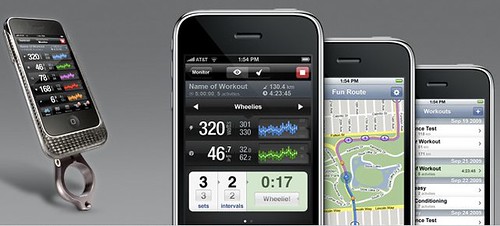
Pedal Brain has a already approved iPhone accessory and developing app ready to try and take on the bike computer market.  The richness of the display data is certainly appealing and they say they are working on battery life.  If they can make their goal of 8 hours (2G only) they’d had a pretty competitive product.  I don’t like the idea of paying a monthly fee for my data … Garmin Connect is free, but this might be cool to have as a commuter.  Not sure I want my iPhone mounted on the handlebar.

Pedal Brain

Via Bike Rumor this am I learned about yet another and more daring approach called ARider. Through the use of augmented reality a Japanese researcher is looking to overlay mapping data into your view – live. This is certainly cool sounding in theory, but it looks (and I know it’s just research now) way too wonky. I can’t see projecting anything across my field of vision while riding at speed or in a city. I want my vision clear!  I also really can’t see having my iphone helmet mounted …

In each of these cases, I’d be willing to bet it would not be long until you ran into the need to run another app (inbound call, arriving email etc) that would start to reveal the limits of a single tasked device. The nice thing about using a bike computer is that it totally stays out of the way and lets you focus on riding. I glance down for a look at my progress, but spend my time really checking out the data when off the bike …

Google Latitude Location Alerts

latitude location alert

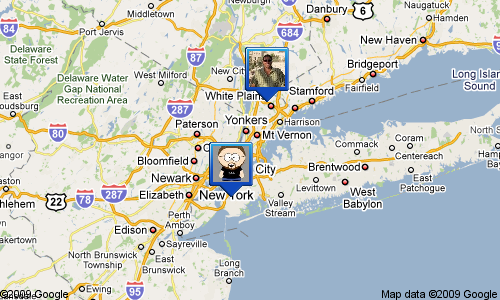
On my way home tonight I fired up Google Maps to get an address and since I use Latitude, I was also activating my location.  I got an sms telling me my friend and colleague Will was “nearby.”  I received the image above in an email with a similar message …

I actually had forgotten I had turned on these location settings, and now that I see how they really function, I have a few suggestions:

  • 50+ KM is not exactly a practical range for spur of the moment meetups for starters.  Will was 52km away when the alert triggered …
  • There’s no contact number in the sms alert which forces a few more steps to contact (call or sms) the person

I love the idea of social location and if you follow me across various services I’m sure you’ve noticed as well.  What Google is doing is trying to make it easy through the use of location history, but it’s still unclear how that works without constantly opening Maps.  I can’t afford to let Latitude project my location in the background all day as GPS tends to eat batteries …   I’m wondering if there isn’t some sort of data partnership to be had with the various check-in services (or even Yelp!) to augment the more direct GPS tagging you do with maps.  The more data in the mix here the more valuable the results.

Btw – Will developed the Michael Ruhlman Ratio iPhone app – be sure to check it out!

Mag+

Mag+ from Bonnier on Vimeo.

This is a really slick prototype for a future e-magazine reader.  I really like how they are not looking to make it play video or fake the page turn.  The experience is focused and lets you enjoy reading – yet in a beautiful digitally enhanced manner.

I recommend playing the video back in fullscreen mode.

A small wishlist for the iPhone in 2010

The more I use a a variety of mobile devices I keep coming back to a few seemingly arbitrary limits of the iPhone. I’m hoping the following issues are resolved in a future release:

If I can’t have all apps multitask I would prioritize media playing apps. There is no reason why listening to audio needs to monopolize a device – ever. This is not a radio, it’s a pocket computer come on!

While on the topic of media, it also seems quite abitrary that Apple’s core app functions are not available to things like Pandora or Last.fm. Why can’t I see the album art like from the ipod when waking the screen? Why can’t the remote button on our headphones also control these 3rd party apps.

These are details but severly limit how the iphone works.

One final nit I have is regarding voice control. I’d like to know what genius thought it should just be on all the time with headphones?! As a result my music is constantly interrupted by the iphone’s expectation of a voice command. This only seems to happen with the standard headphones but happens both indoors as well as out.

The difference between Google and Nokia

While this is hardly a definitive view, I think it’s an excellent example which highlights a key difference  in how Nokia and Google have gone to market with very similar ideas.

Ovi Prime Place and Google’s Favorite Places both seek to link physical businesses with mobile maps.  The main difference and it’s likely to be critical here is that Google has proactively seeded 100K businesses with QR code stickers and listings while The Nokia Ovi team has decided to leave the map blank and invited businesses in to create their listings …   without any marketing.

Which do you think will grow more quickly and succeed?

What about the Google Phone is Going to matter?

Take a peek on Techmeme and you might think the only story in tech news is the upcoming and likely release of a Google Phone.  I’m sure it will be decent enough but am starting to question the logic a bit given the rumor that the Nexus One as it seems to be called will be sold as an open device, yet on T-Mobile.

I’m definitely a fan of open.  I absolutely prefer that my mobile devices not have restrictions based on operator business development initiatives and instead offer all that the hardware and OS can deliver.  I just don’t see how this device is going to really make that much of a difference for the mainstream consumer – or for T-Mobile.  According to the FCC leak the supported bands will be global and specifically TMO’s (1700) in the US.

If T-Mobile sells and supports the device it will really be a T-Mobile device.  Even if you buy it elsewhere you will need to run it on T-Mobile (again in the US) to actually take advantage of the 3G services and why would you buy an advanced smartphone otherwise?

I would love to be a fly on the way at Verizon Wireless right now.  They just spent gobs of cash launching the Droid which is strongly co-branded Google and has little to no Verizon anywhere.  Maybe they jumped the gun on going for Droid so quickly when big G had this cooking (to compete) all along …

I’m wondering whether Google might be looking to upend the subsidy market by  taking on the cost directly in exchange for all the lovely data they track … assuming a Google phone is like the G1 in that you must have a Google Account for it to work.  I tend to agree with Ewan that this really is going to be a price play.  It’s unlikely that this will be the phone for me, and I do wonder who an open Android device is for just now … Looking forward to seeing how this all plays out.